

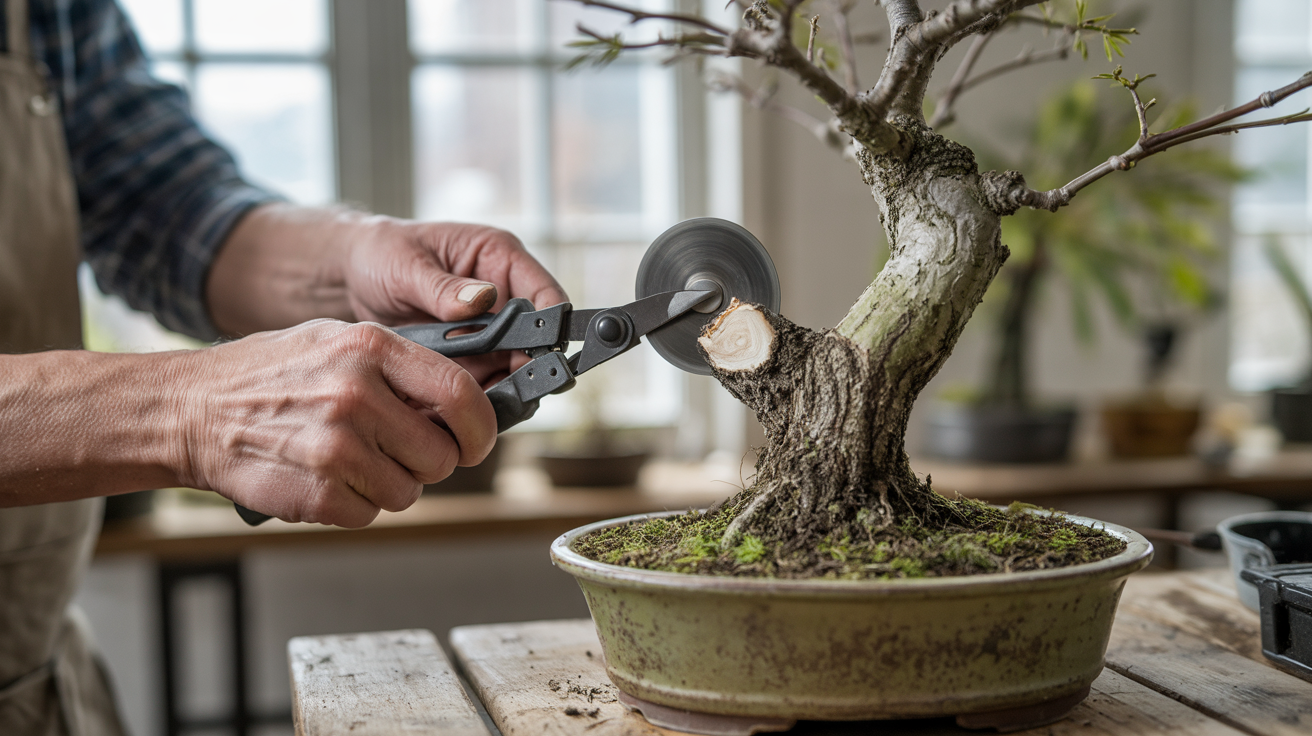
Why the Concave Cutter Deserves More Respect Than Your Average Bonsai Buyer Gives It
Every few months, a product listing surfaces that reminds us just how casually the bonsai community treats one of its most consequential tools. The recent attention around the Zerodis 205mm concave bonsai cutter — a manganese steel alloy pruner marketed for both branch trimming and root work — is one of those moments. And we think it’s worth pausing on, not to review the product itself, but to address a wider problem: most beginners, and even a surprising number of intermediate growers, fundamentally misunderstand what a concave cutter actually does, and when it should be used.
The Concave Cut Is Not Just About Aesthetics
The defining characteristic of a concave cutter is its curved blade profile, which removes a small scoop of tissue below the cut surface. The result is a wound that heals inward rather than forming a proud, raised knob. This matters enormously on hardwood deciduous species — think Zelkova serrata, Acer palmatum, and Carpinus japonica — where the cambium layer rolls over a hollow wound site more cleanly and predictably than it does over a flat one. What most guides get wrong is treating concave cutters as a universal branch-removal tool. They are not. On soft-tissued species like Ficus microcarpa or Portulacaria afra, the aggressive scooping action can open wound sites so wide that the callus struggle to close before rot sets in, particularly in humid growing environments.
Timing Your Cuts: This Is Where Most Growers Lose
Steel quality matters, but it matters far less than cut timing. For temperate deciduous species, we would argue strongly that the ideal window for major branch removal using a concave cutter is late winter — specifically the two to four weeks immediately before bud swell begins. In Acer palmatum, that often means February in temperate climates, when the tree’s energy reserves are primed to mobilize but dormancy still limits excessive sap bleeding. Cutting in late autumn, by contrast, leaves wounds exposed through the coldest months without active callus formation, inviting fungal ingress.
A Concrete Technique for Cleaner Wound Closure
- Make your initial removal cut about 5mm proud of the final wound site, leaving a short stub.
- Allow the stub to dry and die back fully over two to three weeks — this reduces the risk of cellular shock at the cut edge.
- Return with your concave cutter and remove the stub flush, applying the scooping motion toward the trunk’s heartwood, not parallel to the bark surface.
- Apply cut paste immediately — a paste containing trichoderma fungi is preferable on hardwoods for its active colonization against wood-rot pathogens.
- Check the wound site at six to eight weeks; on a healthy Zelkova, you should see a visible callus roll beginning from the wound margin.
What the Tool Conversation Is Really About
When growers debate steel alloys and blade profiles — as the listing covered at umlconnector.com — the underlying question is really about confidence in the cut. A well-maintained concave cutter of modest steel grade, sharpened before each session and cleaned with isopropyl alcohol between trees, will outperform an expensive neglected one every single time. Manganese steel alloys do offer meaningful resistance to edge deformation, which is relevant for root work where grit contact is unavoidable. But that advantage evaporates without consistent maintenance.
Our Take
We think the concave cutter is the single most misused tool in the hobby — bought eagerly, applied too broadly, and rarely sharpened. Its value is species-specific and season-specific, and treating it otherwise is how you end up with wound sites that take five years to close on a tree that should have healed in eighteen months.
Actionable takeaway: Before your next branch removal on any deciduous species, check whether you’re within that late-winter pre-bud-swell window. If you’re not, stub the branch and wait. The cut you make at the right moment is worth three times more than one made with premium steel at the wrong time.
Related reading: Why Dressing Your Bonsai for the Holidays Is Smarter Than You Think — particularly relevant if you’re heading into the winter display season and wondering how wound care intersects with cold-weather tree presentation.
By Redazione Bonsai World
Article researched and written with AI assistance and reviewed by the Bonsai World editorial team.