
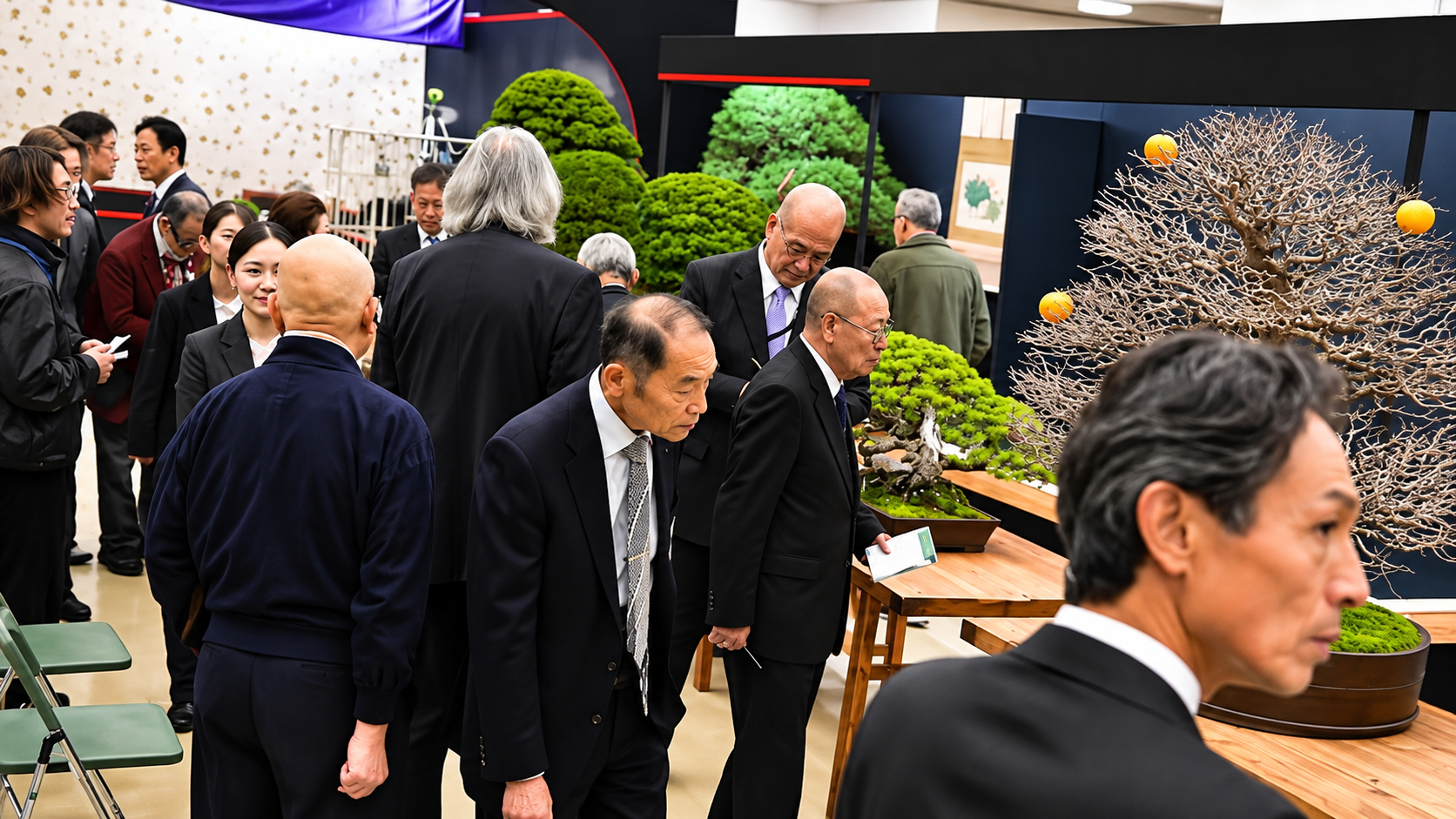
From November 20 to 23, Japan’s Nihon Bonsai Taikanten takes place in Kyoto. Held annually, this prestigious event reached its 46th edition in 2026.
The exhibition is held at the Kyoto International Exhibition Hall, also known as Miyako Messe.
It is one of Japan’s most eagerly anticipated and prestigious bonsai exhibitions and arguably one of the most important in the world. The bonsai on display are true masterpieces, showcasing extraordinary beauty and artistic excellence.
But let’s start with an interesting fact: what does Taikanten actually mean?
The full name, Nihon Bonsai Taikanten (日本盆栽大観展), can be translated as “Japan’s Grand Bonsai Exhibition.”
Let’s break down the name:
- 日本 (Nihon) = Japan.
- 盆栽 (Bonsai) = bonsai.
- 大 (Tai) = great or grand.
- 観 (Kan) = to observe or contemplate.
- 展 (Ten) = exhibition or show.
But why Taikanten?
The most interesting part of the name is 大観 (Taikan).
It doesn’t simply mean looking at something. Rather, it conveys the idea of observing something in its full grandeur and entirety, taking in the bigger picture.
In the world of bonsai, this evokes a holistic appreciation of nature, art and beauty.
The event describes itself as one of Japan’s largest indoor bonsai exhibitions. An interpretative translation that captures its spirit particularly well would be: “Japan’s Grand Exhibition of the Art of Bonsai.”
WHO ORGANIZES THE TAIKANTEN?
Behind this impressive event is a rather substantial organizational effort.
The exhibition is organized by a committee involving five different organizations:
- Nihon Bonsai Taikanten Exhibition Organizing Committee.
- Kyoto City.
- Kyoto Shimbun (local newspaper).
- KBS Kyoto (television broadcaster).
- Nippon Bonsai Growers Cooperative.
The event also receives support from several major sponsors, including Kyoto International Cultural Foundation, Keiun-an, TANAX Inc., Kindai Shuppan Co., Ltd. and S-Press Media Publishing Co., Ltd.
Furthermore, the exhibition enjoys the support of numerous government institutions and industry associations, including:
- Ministry of Agriculture, Forestry and Fisheries.
- Ministry of Foreign Affairs.
- Kyoto Prefecture.
- Shiga Prefecture.
- Japan Bonsai Association.
- Japan Satsuki Association.
- Japanese Shohin Bonsai Association.
- And many other organizations within Japan’s bonsai community.
Admission to the exhibition costs 1,500 yen, approximately €8.90.
But now let’s get to the really interesting part!
3 INSIDE STORIES YOU MAY NOT KNOW ABOUT THE TAIKANTEN
1. A ONE-MILLION-DOLLAR BONSAI!
A Japanese white pine was once exhibited at the Taikanten after having been offered for sale in 2011 at an international event in Takamatsu for the astonishing sum of one million dollars.
That same bonsai subsequently went on to win the prestigious Prime Minister’s Award at the 2017 Taikanten.
A one-million-dollar tree! Now that’s a whole different level of potted plant!
2. BONSAI THAT ONCE BELONGED TO JAPAN’S LAST SHOGUN!
At the 2017 Taikanten, four Japanese white pines, each approximately 250 years old, were exhibited. They had once belonged to Tokugawa Yoshinobu, the last shogun of Japan.
These were not just trees: they were genuine pieces of Japanese history.
A suiseki, a natural stone displayed for contemplation, exhibited on the same occasion also came from the shogun’s collection.
What makes this story even more fascinating? These treasures had eventually found their way into a private collection and were entrusted to the care of a bonsai master.
3. BONSAI AS AN INVESTMENT FOR MILLIONAIRE COLLECTORS!
At the 2019 Taikanten, bonsai were offered for sale at some truly staggering prices:
- $30,000.
- $180,000.
- $350,000.
We are not talking about ordinary trees here, but specimens that have been carefully developed over decades and come from prestigious collections.
What’s particularly interesting is that, in the bonsai market, a tree’s value is determined by much more than its age. Its provenance, history, the reputation of the artist who worked on it and, of course, its artistic quality all play a crucial role.
In other words, behind these “little trees” lies a truly high-end international market!
So, did you already know about these fascinating stories behind the Taikanten?
Which of these facts surprised you the most?