
Why Most Beginner Bonsai Advice Sets You Up to Fail
We have seen it happen dozens of times in our community: a newcomer picks up a Chinese elm or a juniper, reads a handful of care sheets, waters dutifully, and then watches the tree decline anyway. The tree yellows, the soil stays soggy, and the grower assumes they simply lack a “green thumb.” What they actually lack is advice that is honest about where generic beginner guides consistently go wrong. There is no shortage of introductory bonsai content online — including recent roundups aimed at first-time growers — but most share the same structural flaw: they treat watering, light, and repotting as universal rules rather than species-specific conversations.
The Advice That Gets Quietly Left Out
Here is what we would argue most beginner guides get fundamentally wrong: they recommend a watering schedule. Water every two days, water when the top centimetre of soil is dry — these are heuristics that collapse the moment you change species, pot size, season, or climate. A Ficus retusa sitting in a glazed ceramic pot in a humid coastal apartment needs watering at a completely different frequency than the same species in a terracotta pot on a south-facing balcony in midsummer. Prescribing a schedule is not caution — in our view, it is a shortcut that erodes the very observation skills bonsai is supposed to teach.
The second omission is perhaps more damaging: most guides treat outdoor and indoor bonsai as equivalent categories. They are not. Temperate species like Juniperus chinensis, Acer palmatum, and Pinus thunbergii require genuine winter dormancy. Keeping them in a warm living room year-round does not merely slow their growth — it progressively weakens the tree until it cannot recover. We lose count of the messages we receive from growers who were simply never told this.
A Concrete Technique: Reading Soil Moisture Without a Schedule
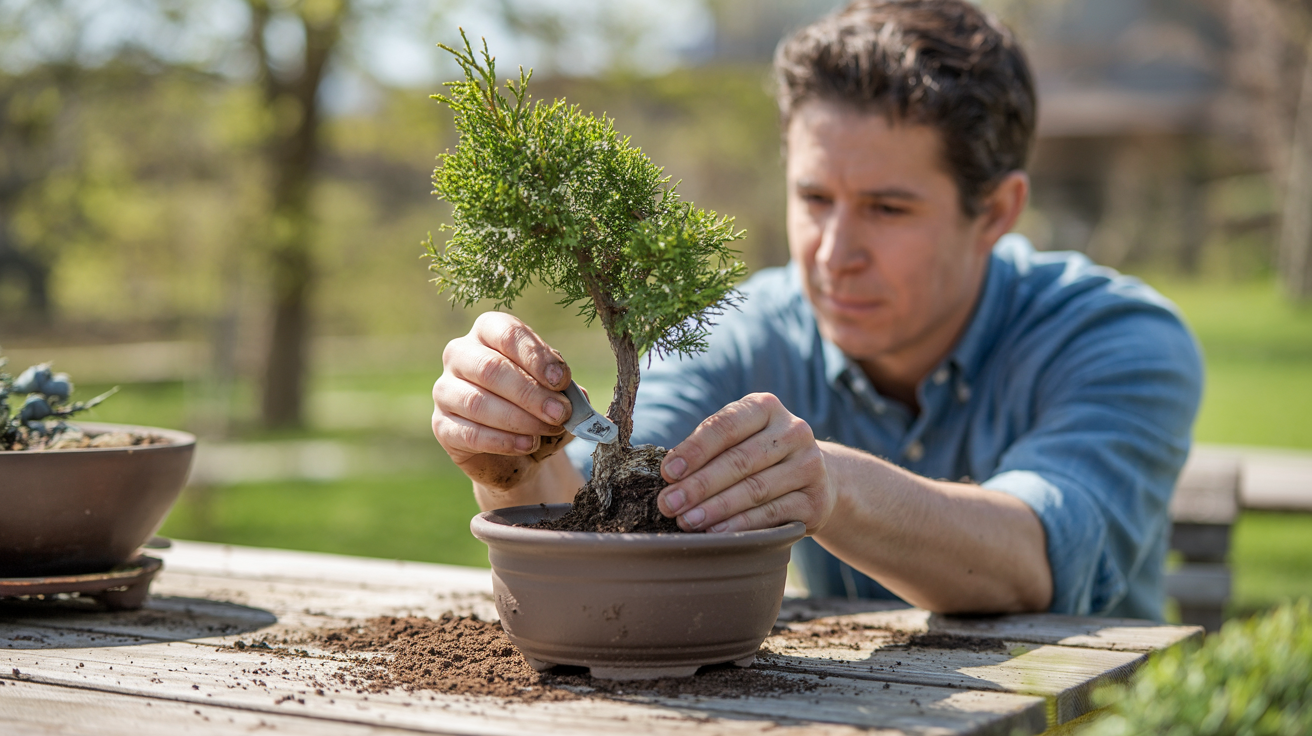
Rather than watering on a timetable, we recommend training yourself to read the pot. Here is a short sequence that works regardless of species:
- Lift the pot. Before watering, note its weight. After watering thoroughly — until water runs freely from the drainage holes — lift it again. That heavy feeling is your “fully watered” baseline.
- Check daily by lifting, not by probing the surface. Soil surface moisture is almost always misleading with akadama-heavy mixes, which skin over quickly while the lower layers remain damp.
- Water again only when the pot feels noticeably lighter and the soil two centimetres deep, tested with a thin wooden skewer, comes out barely damp or dry.
- In late spring through early summer, most outdoor deciduous species in free-draining bonsai soil will need watering once or twice daily during the active growth flush. Do not be alarmed — this is normal and healthy.
This method recalibrates your instincts rather than replacing them with a number, which is exactly the kind of skill that separates growers who thrive from those who stall.
Our Take
Bonsai culture deserves better than a checklist. The art has enough depth — and enough cultural weight, which we have explored separately in our piece on When “Bonsai” Becomes a Slur: Our Responsibility to Reclaim the Word — that reducing it to five bullet points does the practice a quiet disservice. We are not saying beginner guides are useless. We are saying they work best when they teach observation rather than routine.
Species matter. Timing matters. The difference between repotting a Prunus mume in early February, just as buds swell, versus repotting it in autumn when reserves are spent, is not a footnote — it is the difference between a tree that doubles its vigour and one that sulks for two seasons.
Actionable Takeaway
Today, before you water, lift your bonsai pot with both hands and hold it for five seconds. Tomorrow, do the same. By the end of one week, you will have a physical memory of that pot’s weight cycle that no schedule could give you. Start there.
By Redazione Bonsai World
Article researched and written with AI assistance and reviewed by the Bonsai World editorial team.