
Stop Watering Your Bonsai Like It’s a Houseplant
We see it constantly in reader questions, forum threads and club workshops: growers treating their bonsai’s water schedule like a fixed appointment. Water on Monday, water on Thursday, done. In our view, this single habit is responsible for more dead trees than any pest, fungus or styling mistake combined — and almost every beginner guide on the market quietly enables it by burying the nuance in a footnote.
The broader conversation about bonsai care basics has been circulating again lately, with general bonsai care tips making the rounds on MSN. These round-ups serve a purpose — they get curious newcomers through the door — but they tend to flatten species-specific reality into a single, safe, vague answer. We want to push past that.
What Most Guides Get Wrong About Watering
The dominant advice is to “water when the topsoil feels dry.” For a Ficus retusa sitting indoors in a humid flat, that is reasonable. For a Japanese white pine (Pinus parviflora) in a shallow Tokoname pot outdoors in July, it is dangerously slow. The substrate drains faster, the sun load is extreme and the shallow pot volume offers almost no buffer. By the time the surface reads dry, the fine feeder roots at mid-depth may already be desiccating.
Equally misunderstood is the relationship between watering and the growing season. Most guides treat spring as the obvious time to be careful. We would argue the more dangerous window is late summer — specifically August into early September in temperate climates — when Acer palmatum (Japanese maple) and Zelkova serrata bonsai are still in active growth but growers have mentally begun to ease off. Underwatering during this window stunts the second flush of growth and weakens the root mass going into dormancy.
A Concrete Technique: The Chopstick Moisture Test
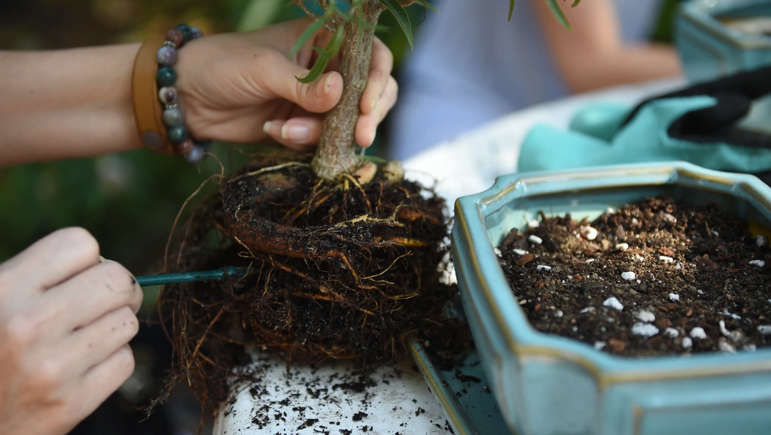
Rather than relying on surface touch, we recommend the chopstick method — and we mean this precisely, not metaphorically:
- Insert an unvarnished wooden chopstick vertically into the substrate to a depth of roughly 3–4 cm, stopping short of the root mass.
- Leave it in place for 60 seconds, then withdraw it slowly.
- If the wood surface comes out clean and pale, water immediately and thoroughly until runoff exits the drainage holes.
- If it comes out with dark staining or particles clinging to it, the mid-level substrate still holds moisture — hold off and test again in a few hours.
This is particularly reliable for akadama-dominant mixes, which can appear pale and dry on the surface while retaining meaningful moisture below. It costs nothing and takes under two minutes, yet it communicates what finger-touch never can: what is happening beneath the surface layer where the roots actually live.
Our Take
Bonsai care literature has a tendency to reassure rather than inform. The comfortable, calendar-based watering advice persists because it sounds manageable. But bonsai is not manageable on a schedule — it is manageable through observation. A Juniperus chinensis in a terracotta training pot on a south-facing balcony in August may need water twice in a single day. That same species, same pot, on a cloudy English October afternoon, may need nothing for three days. If you treat those two situations identically, one of them will punish you.
We have written before about how autumn in particular exposes the gap between confident assumption and actual tree knowledge — our piece on why fall is the most honest season for bonsai goes deeper on that theme.
Actionable Takeaway
Today, before your next watering, use the chopstick test on every tree you own. Log what you find. After one week of daily testing, you will know each tree’s actual moisture rhythm — and you will never go back to watering by the calendar again.
By Redazione Bonsai World
Article researched and written with AI assistance and reviewed by the Bonsai World editorial team.